Duval Triangle Method for DGA Interpretation
The Duval Triangle is a graphical method for interpreting Dissolved Gas Analysis (DGA) results from transformer oil samples. It helps identify the type of fault occurring in oil-filled electrical equipment.
Enter Gas Concentrations (ppm or %)
Duval Triangle 1
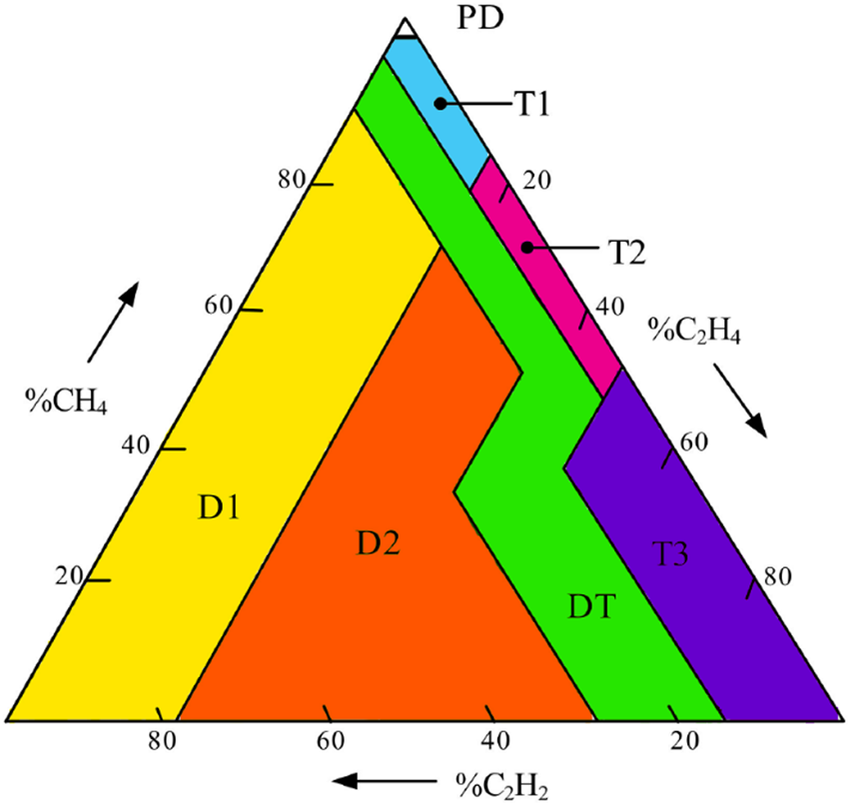
Enter gas concentration values and click "Analyze" to see the fault diagnosis.
Fault Region Legend
About the Duval Triangle Method
Developed by Michel Duval in the 1970s, the Duval Triangle is one of the most widely used methods for interpreting DGA results. It uses the relative proportions of three key gases:
- Methane (CH₄) - Produced by low-temperature oil decomposition
- Ethylene (C₂H₄) - Produced by high-temperature oil decomposition
- Acetylene (C₂H₂) - Produced by electrical arcing and very high temperatures
By normalizing these three gas concentrations to 100% and plotting them on a triangular coordinate system, the method identifies seven distinct fault zones.
Fault Types Explained
PD - Partial Discharge
Corona discharges in gas-filled cavities. Typically produces hydrogen and small amounts of methane. Usually found in high-voltage equipment with voids in insulation.
D1 - Low Energy Discharge
Sparking between components with different potentials, or breakdown of oil. Creates small arcing events with limited energy.
D2 - High Energy Discharge
Major arcing events with high local energy. Causes significant damage, carbonization of oil, and may be accompanied by tripping.
DT - Thermal & Electrical Mix
Indeterminate zone indicating a combination of thermal and electrical faults. Further investigation recommended.
T1 - Thermal Fault < 300°C
Low-temperature overheating affecting paper insulation or oil. Often from bad connections or circulating currents.
T2 - Thermal Fault 300-700°C
Medium-temperature overheating. Indicates more severe thermal stress requiring attention.
T3 - Thermal Fault > 700°C
High-temperature overheating exceeding 700°C. Severe fault condition that may involve conductors or core. Immediate action typically required.
How to Use This Tool
- Obtain DGA results from your transformer oil sample analysis
- Enter the concentrations of CH₄, C₂H₄, and C₂H₂ (in ppm or any consistent unit)
- Click "Analyze" to plot the point on the triangle and identify the fault type
- Review the diagnosis and take appropriate action based on the fault type
Note: The Duval Triangle should be used alongside other diagnostic methods and expert judgment. Always consult with qualified engineers for critical decisions.
References
- • IEC 60599 - Mineral oil-filled electrical equipment in service - Guidance on the interpretation of dissolved and free gases analysis
- • IEEE C57.104 - Guide for the Interpretation of Gases Generated in Mineral Oil-Immersed Transformers
- • Duval, M. (2002). A Review of Faults Detectable by Gas-in-Oil Analysis in Transformers. IEEE Electrical Insulation Magazine.